In many manufacturing facilities across Vietnam, vacuum furnaces are critical assets that directly impact product quality and production efficiency. However, in reality, most major failures such as vacuum furnace transformer burnout, motor damage, and unexpected downtime are not caused by mechanical issues, but by poor power quality. 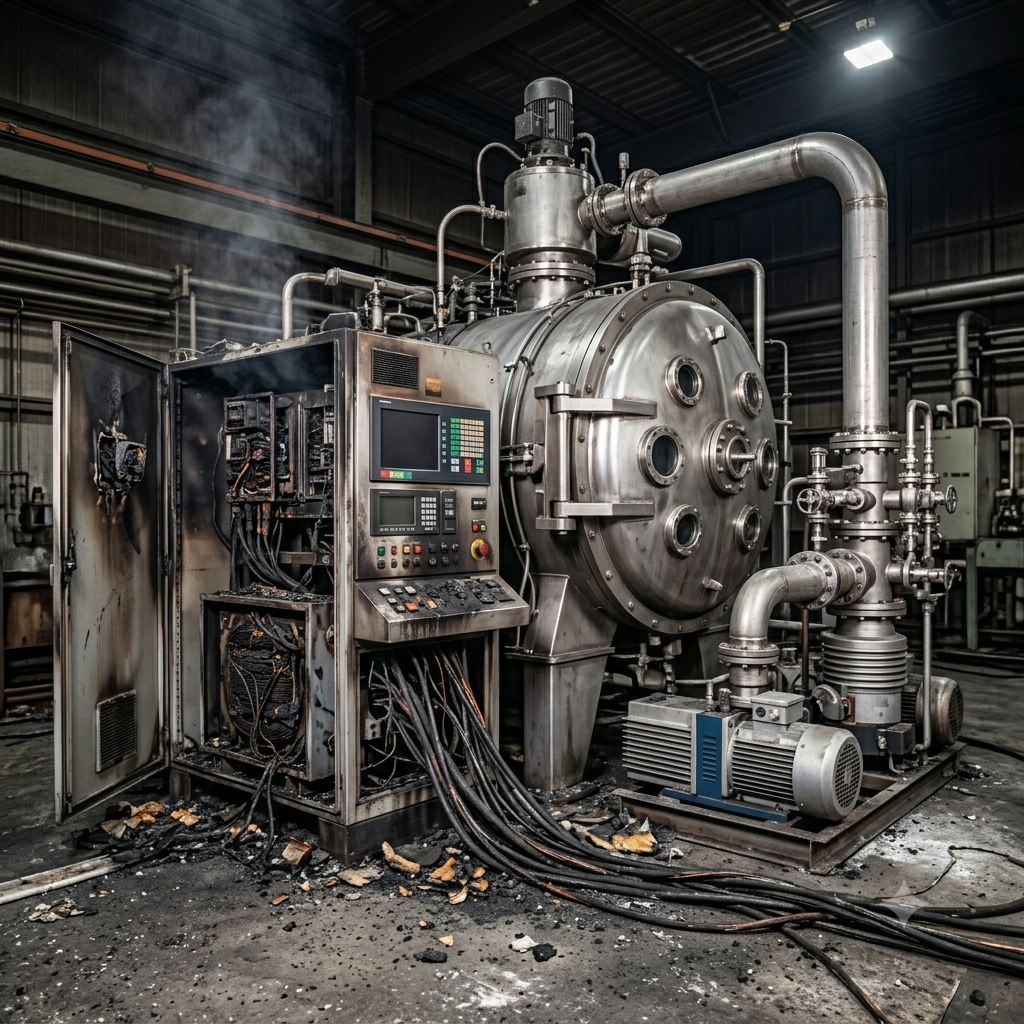
The combination of unstable grid power and high-power loads such as SCR systems, transformers, and motors creates a dangerous chain reaction that gradually degrades equipment from within — often without obvious warning signs.
In this article, ULVAC Vietnam analyzes the core physical mechanisms and provides systematic prevention solutions.
1. Voltage Drop – Current Increase: The Root Cause of Transformer Failure
In vacuum furnace operation, transformers rarely fail due to instantaneous overload. The main cause is prolonged operation under unstable voltage conditions.
Electrical power is defined by the formula: P = U × I
Where:
- P is power (Watt)
- U is voltage (Volt)
- I is current (Ampere)
When the input voltage U drops due to weak or overloaded power grids, the SCR control system increases the firing angle to maintain thermal output.
As a result, current I increases to compensate for the power loss.
Heat loss in windings is defined by: Q = I² × R
This leads to a critical effect:
- 10% increase in current → ~21% increase in heat
- 20% increase in current → ~44% increase in heat
This process causes:
- Insulation aging
- Micro-cracking
- Partial discharge
- Arc formation
Once the critical threshold is exceeded, transformer failure can occur within seconds. 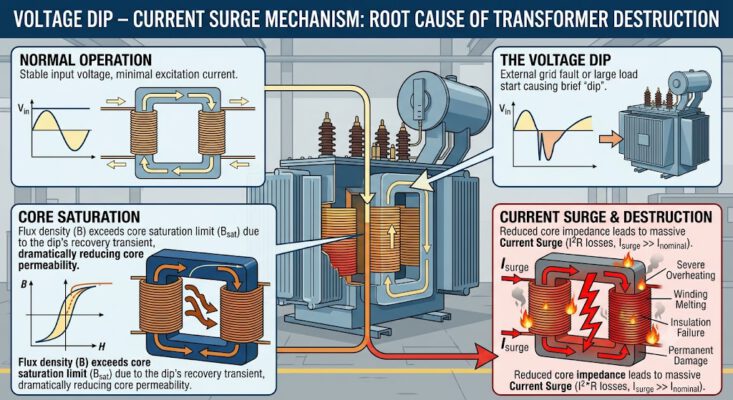
2. Motors and Vacuum Pumps: Underrated Risk Sources
Motors in vacuum systems typically run continuously but are often overlooked in power quality management.
Direct-On-Line (DOL) Starting and Inrush Current
When motors are started using DOL, the starting current can reach:
I_start = 6 to 8 × I_rated
This sudden current surge causes:
- High electromagnetic forces in stator windings
- Mechanical deformation
- Vibration and insulation degradation
Over time, this leads to winding failure and motor burnout.
Phase Loss and Voltage Imbalance
In three-phase systems, voltage imbalance leads to current imbalance:
I_unbalance ≈ 6 to 10 × V_unbalance
Even a 3% voltage imbalance can significantly increase motor temperature. At 5%, winding temperature may rise by 20–30%.
Consequences include:
- Reduced insulation lifespan
- Stator winding failure
- Vacuum system shutdown
3. Hidden Weak Points in Real Operation
The lifespan of identical equipment can vary significantly depending on operation and maintenance practices.
Not the equipment — but how it is managed.
Early Warning Signs:
| Factor | Symptom | Actual Risk |
|---|---|---|
| Busbar / Terminal | Brown discoloration, >70°C | Increased contact resistance → localized heating |
| 3-phase voltage | >3% imbalance | Increased current → motor overheating |
| SCR alarms | Frequent triggering | Weak or distorted power supply |
| Cooling water | Reduced flow rate | Insufficient heat dissipation |
| Pump oil | Contaminated or degraded | Increased motor load |
Ignoring these small issues leads to cumulative failures.
4. Harmonics and Voltage Distortion: The Invisible Threat
Non-linear loads such as SCR systems and inverters generate harmonics in the electrical system.
Total Harmonic Distortion (THD) is used to measure this effect.
When THD is high, the following occurs:
- Increased core loss and eddy current loss in transformers
- Higher operating temperature even without overload
- Control signal interference
- Measurement inaccuracies
Harmonics do not cause immediate failure but significantly accelerate equipment degradation.
5. Power System Optimization Solutions for Vacuum Furnaces
To prevent failures, a multi-layer protection strategy is required instead of isolated fixes.
5.1 Voltage Stabilization and Power Quality Control
- Install industrial voltage stabilizers
- Use harmonic filters (active or passive)
- Separate power sources for critical loads
Target operating conditions:
- Voltage stability within ±2%
- THD less than 5%
5.2 Use Variable Frequency Drives (VFD)
Replacing DOL starting with VFD provides:
- Reduced starting current close to rated current
- Better load and speed control
- Reduced electrical and mechanical stress
- Extended motor lifespan
5.3 Electrical Protection System
Essential protection devices include:
- Overcurrent relays
- Thermal relays
- Phase loss relays
- PLC interlock systems
Operational rule:
If current exceeds 105% of rated value for 30 seconds, the system must trip to protect equipment.
5.4 Monitoring and Data Analysis
Implement continuous monitoring for:
- Current
- Voltage
- Temperature
- Vibration
Trend analysis helps detect abnormalities before failure occurs.
5.5 Preventive Maintenance
- Insulation resistance testing (Megger) every 6 months
- Tightening electrical connections
- Cooling system inspection
- Scheduled pump oil replacement
Decreasing insulation resistance is a critical indicator of potential failure.
Conclusion
Transformer and motor failures in vacuum furnaces are not random events. They are the result of a chain of electrical phenomena:
- Voltage drop leading to increased current and overheating
- Phase imbalance causing load imbalance
- Harmonics accelerating losses and insulation aging
Understanding these physical mechanisms is key to improving system reliability and extending equipment lifespan.
ULVAC Vietnam – Optimizing Your Vacuum Furnace Power System
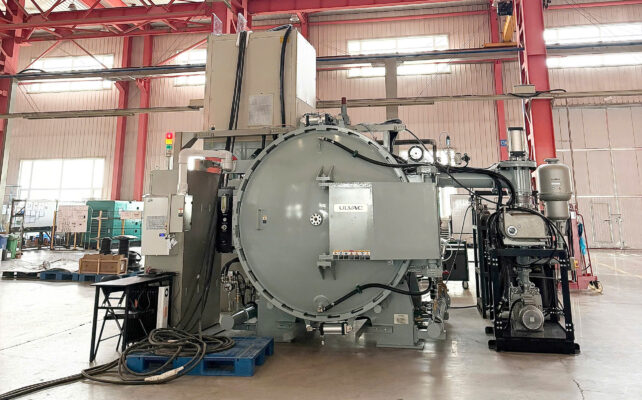
ULVAC Vietnam provides comprehensive solutions for vacuum furnace systems:
- Power quality assessment
- Harmonic analysis
- Electrical system inspection
- Industrial load optimization