With the rapid development of AI Servers, Data Centers, electric vehicles (EVs), and high-power electronic equipment, the importance of Cooling Modules continues to grow.
Cooling Modules play a critical role in controlling operating temperatures and maintaining the stable performance of these systems. However, because Cooling Modules consist of various components such as liquid flow channels, welded joints, connections, seals, and O-rings, even a small leak can affect product quality and reliability.
If Cooling Module Leak Testing is not properly implemented during the manufacturing process, it can lead to cooling performance issues, product defects, increased production costs, and reliability problems.
In this article, we will discuss 5 common problems in Cooling Module Leak Testing and how an Auto Leak Test System can help address these challenges.
1. Difficulty Detecting Small and Micro Leaks
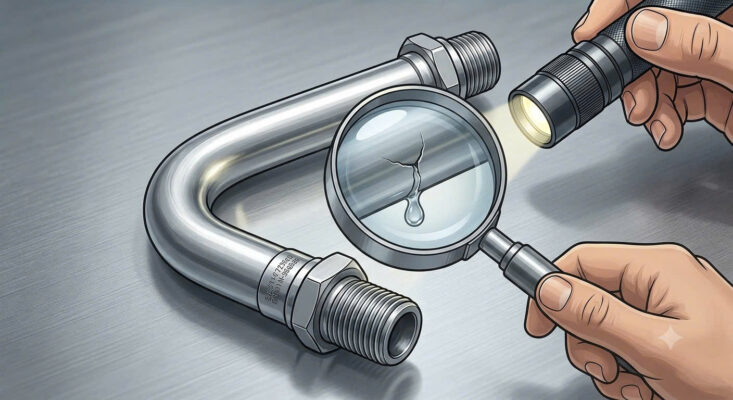
One of the most common challenges in Cooling Module Leak Testing is accurately detecting small or micro leaks.
Cooling Modules may have potential leak points in various areas, including:
- Welded joints
- Cooling liquid channels and piping
- Connections
- Fittings
- O-rings and seals
- Joints and bonding areas
When the leak rate is extremely low, visual inspection may not be sufficient. Conventional testing methods may also have limitations when detecting very small leaks.
In actual production environments, even a small leak can eventually lead to coolant loss, reduced cooling performance, or product failure during long-term operation.
Therefore, manufacturers need a precise Leak Test method that matches the required Leak Rate of the Cooling Module.
2. Long Test Times Affect Production Cycle Time
Another common issue is that a long Leak Test time can increase the overall Cycle Time of the production process.
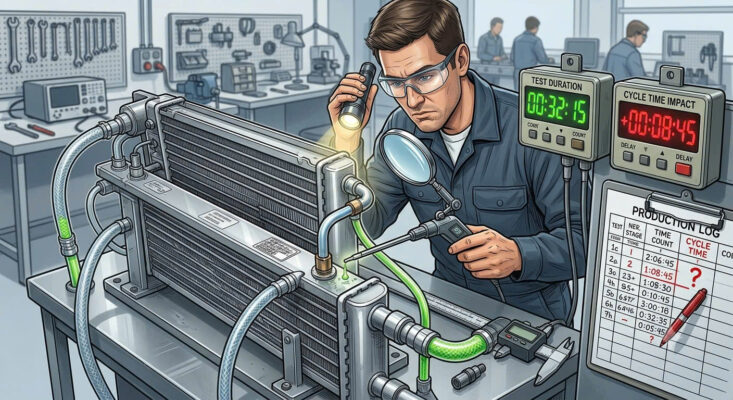
A typical manual leak testing process may include:
Loading → Connecting → Testing → Result Analysis → PASS/FAIL Judgment → Unloading
When operators are required to manually connect products, configure test conditions, and check the results, the testing time per product can increase.
As production volume increases, even a small increase in test time can have a significant impact on overall productivity.
The Leak Test process can also become a production bottleneck, limiting the capacity of the entire manufacturing line.
For high-volume production, it is therefore important to consider not only test accuracy but also Cycle Time optimization when designing a Cooling Module Leak Test System.
3. Variations in Test Results Between Operators
Manual Leak Testing can produce variations in test results depending on operator experience and working methods.
Several factors can affect the test results, such as:
- Product connection conditions
- Test Time
- Pressure or Vacuum conditions
- Stabilization Time
- Equipment settings
- PASS/FAIL judgment criteria
If different operators or shifts use different testing methods, the same product may receive different PASS/FAIL results.
Such variations can make it difficult to maintain consistent quality standards and may also complicate defect analysis and production process improvement.
For this reason, manufacturers need to standardize Leak Test conditions and judgment criteria while minimizing operator intervention.
4. Difficulty Integrating Leak Testing into an Automated Production Line
As Cooling Module production becomes increasingly automated, Leak Testing also needs to be integrated into the overall automated production line.
However, simply installing a Leak Detector is not enough to fully automate the process.
Depending on the production requirements, the Leak Test System may need to communicate with and integrate with:
- Robot
- Conveyor
- PLC
- HMI
- Production Management System
For example, a typical automated process may be structured as:
Conveyor → Robot Loading → Auto Leak Test → PASS/FAIL Signal → Sorting → Next Process
The system must also consider the existing production line layout, Cycle Time, product handling method, and control architecture.
Therefore, a Cooling Module Leak Test System should be designed as part of the overall production automation process, rather than as an independent inspection machine.
5. Difficulty Managing Leak Test Data and Traceability
The fifth challenge is effectively managing and tracking Leak Test data.
In a modern manufacturing environment, simply recording PASS or FAIL is often not enough. Manufacturers may need to collect and manage data such as:
- Product ID
- Lot Number
- Leak Value
- PASS/FAIL Result
- Test Time
- Test Conditions
- Machine Data
- Inspection History
If data is recorded manually or stored separately across different machines, identifying the root cause of a quality problem can take significant time.
By linking inspection data with individual products and production history, manufacturers can improve Traceability, perform more effective Root Cause Analysis, and identify quality trends.
This data can also be used to optimize production processes and improve overall manufacturing quality.
How Can These Cooling Module Leak Testing Problems Be Solved?
To achieve a stable and reliable Cooling Module Leak Test process, manufacturers should consider more than just selecting a Leak Detector.
A complete Leak Test System should be designed based on the product characteristics, required Leak Rate, production volume, Cycle Time, automation level, and production line requirements.
ULVAC Auto Leak Test System – Automated Leak Testing Solution for Cooling Modules
The ULVAC Auto Leak Test System can be configured according to the characteristics of the Cooling Module and the requirements of the manufacturing process.

Depending on the application, the system can incorporate:
- Vacuum Pump
- Leak Detector
- Vacuum Chamber
- Automatic Fixture
- PLC & HMI
- Robot Integration
- Conveyor
- Data Management System
The system can be customized according to the customer’s product specifications and production line requirements.
1. Select the Appropriate Leak Test Method Based on the Required Leak Rate
The appropriate Leak Test Method should be selected based on the Cooling Module structure and required Leak Rate.
Common Leak Test methods include:
- Pressure Decay Test
- Vacuum Decay Test
- Air Leak Test
- Helium Leak Test
When extremely small leaks need to be detected, Helium Leak Testing may be applied for high-sensitivity leak detection.
Selecting the right testing method according to the required Leak Rate and inspection objectives is essential for achieving reliable test results.
2. Optimize Cycle Time Through Automation
Automation can combine multiple testing steps into a single automated process:
Loading → Connecting → Testing → PASS/FAIL Judgment → Unloading
Depending on production requirements, technologies such as:
- Robot
- Automatic Loading/Unloading
- Conveyor
- Multi-Station Testing
can be implemented to optimize the Leak Test process.
For high-volume manufacturing, the number of testing stations should be designed based on production volume and required Cycle Time.
3. Standardize Leak Test Conditions
An automated Leak Testing System can help maintain consistent test conditions and reduce variations caused by manual operation.
Test parameters can include:
- Test Pressure
- Vacuum Level
- Test Time
- Stabilization Time
- Leak Rate Criteria
- PASS/FAIL Judgment Criteria
Standardizing these conditions helps reduce variations between operators and production shifts while improving overall quality control.
4. Integrate the Leak Test System with the Automated Production Line
When implementing an Auto Leak Test System into a Cooling Module production line, integration with existing Robot, Conveyor, PLC, and other equipment should be considered.
For example, an automated process can be configured as:
Conveyor
↓
Robot Loading
↓
Auto Leak Test
↓
PASS/FAIL Signal
↓
Sorting
↓
Next Process
Integrating Leak Testing into the production line can reduce manual intervention and improve the overall level of manufacturing automation.
5. Manage Test Data and Improve Traceability
The Auto Leak Test System can be configured to manage product-specific inspection results and Leak Values.
For example, a data flow can be structured as:
Product ID → Test Result → Leak Value → PASS/FAIL → Test Time → Machine Data
By systematically managing Leak Test data, manufacturers can track the inspection history of each product and use the information for Root Cause Analysis, quality improvement, and production optimization.
Key Factors When Selecting a Cooling Module Leak Test System
When selecting a Cooling Module Leak Test System, manufacturers should consider the following factors.
Product Requirements
- Product type and dimensions
- Product structure
- Internal flow channel structure
- Connection and sealing structure
- Product drawings
Leak Test Requirements
- Required Leak Rate
- Appropriate Leak Test Method
- Test Pressure / Vacuum conditions
- Test Time
- Required Cycle Time
Production Requirements
- Production volume
- Units per hour
- Number of products tested per cycle
- Required number of testing stations
- Automation level
Production Line Integration
- Robot Integration
- Conveyor Integration
- PLC / HMI
- PASS/FAIL Signal
- Automatic Sorting
Data Management
- Product ID management
- Test result storage
- Leak Value recording
- Inspection history
- Integration with production management systems
Conclusion
Cooling Modules are critical components for managing heat in AI Servers, Data Centers, EVs, and various high-power electronic systems.
To maintain stable Cooling Module quality and reliability, manufacturers need an accurate, consistent, and reliable Leak Test process.
Challenges such as micro leak detection, long Cycle Time, operator-dependent test variations, production line integration, and Leak Test data management can be addressed through a properly designed Auto Leak Test System.
Rather than selecting a Leak Detector alone, manufacturers should consider the entire testing process and design a Cooling Module Leak Testing System optimized for the product and production line.
ULVAC can propose an Auto Leak Test System based on the Cooling Module’s product specifications, required Leak Rate, production volume, Cycle Time, and automation requirements.
If you are considering Cooling Module Leak Test automation or production line integration, please contact ULVAC Vietnam to discuss your application and testing requirements.