In industrial vacuum furnace systems, processing temperatures can range from 800°C to over 2,000°C depending on the application, including heat treatment, sintering, vacuum brazing, carburizing, and advanced materials processing. While the heating zone must operate at extremely high temperatures, the furnace shell, door assembly, vacuum system, and supporting components must be maintained within safe operating temperatures. This is precisely the role of the Cooling Water system. 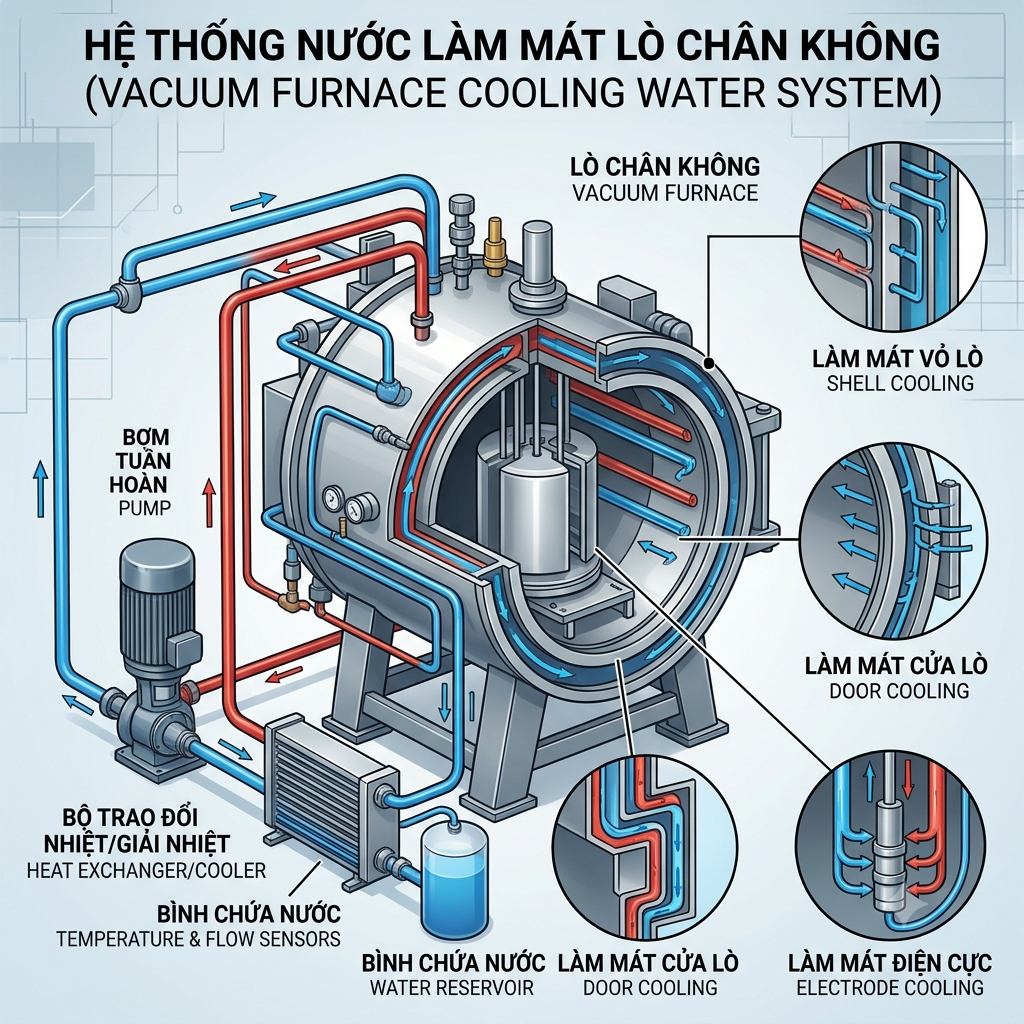
In reality, Cooling Water is far more than a supporting utility. It is one of the most critical protection systems in a vacuum furnace. If the cooling water supply is interrupted or fails to meet specifications, the consequences can include:
- Furnace chamber deformation
- Vacuum seal damage
- Reduced vacuum pump lifespan
- Thermal instability
- Vacuum leakage
- Unplanned production downtime
- Serious safety hazards
So how does Cooling Water work, and why is it so important?
Why Does a Vacuum Furnace Require Cooling Water?
Under high-vacuum conditions, heat transfer through convection is virtually eliminated because the gas molecule density is extremely low.
As a result, most of the thermal energy generated by Graphite or Molybdenum heating elements is transferred through thermal radiation.
According to the Stefan-Boltzmann Law:
Q ∝ T⁴
Where:
- Q = Radiated heat energy
- T = Absolute temperature (K)
- ∝ = Proportional to
This means that thermal radiation increases dramatically as temperature rises. 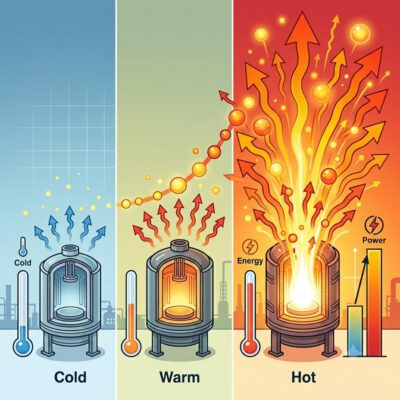
Without effective cooling, this heat would be transferred directly to:
- Furnace shell
- Furnace door
- Flanges
- Electrical feedthroughs
- Vacuum pumping system
To address this challenge, modern vacuum furnaces utilize a Cold Wall design.
Cooling water continuously circulates through a Double-Wall Jacket, absorbing heat and maintaining a safe outer surface temperature.
The Role of Cooling Water in Vacuum Furnaces
1. Protecting the Furnace Structure
Cooling Water helps maintain the external furnace surface temperature below approximately:
60°C (140°F)
This provides several benefits:
- Minimizes structural deformation
- Reduces thermal stress
- Prevents cracking and damage
- Extends equipment service life
2. Protecting Vacuum Seals
Sealing materials such as Viton and other elastomer O-rings have maximum operating temperature limits.
When these limits are exceeded:
- Seal elasticity deteriorates
- Vacuum leaks develop
- Vacuum performance decreases
Cooling Water protects these critical sealing components from prolonged thermal exposure.
3. Reducing Outgassing
When furnace walls become excessively hot, moisture and adsorbed gas molecules on metal surfaces are released at a much higher rate.
This phenomenon is known as Outgassing.
Outgassing can cause:
- Increased chamber pressure
- Vacuum contamination
- Product oxidation
- Reduced process quality
Maintaining cooler furnace walls significantly reduces outgassing effects.
Components That Require Cooling Water
1. Vacuum Furnace Chamber
The furnace chamber typically consumes the largest cooling water flow.
Water circulating through the double-wall jacket absorbs the majority of radiated heat generated inside the hot zone.
2. Vacuum Pumping System
Many vacuum pumps require continuous cooling, particularly:
- Diffusion Pumps
- Large Mechanical Pumps
- Booster Pumps
Loss of cooling water may result in:
- Pump oil overheating
- Reduced pumping efficiency
- Increased backstreaming risk
- Equipment damage
3. Quenching Heat Exchanger
During high-pressure gas quenching with Nitrogen or Argon, enormous amounts of heat must be removed rapidly.
Cooling Water helps:
- Increase cooling rates
- Protect heat exchangers
- Ensure process stability
4. High-Current Power Feedthroughs
Copper conductors often carry electrical currents of several thousand amperes.
Heat generation follows Joule’s Law:
P = I²R
Where:
- P = Heat power (W)
- I = Electrical current (A)
- R = Electrical resistance (Ω)
Cooling Water is circulated directly through these conductors to prevent overheating and protect insulation systems.
Cooling Water Quality Requirements
Not all water sources are suitable for vacuum furnace cooling applications.
Poor water quality can cause serious issues.
1. Scaling
Calcium and magnesium ions may precipitate and form insulating deposits inside pipes and cooling channels.
Consequences include:
- Reduced heat transfer efficiency
- Localized hot spots
- Increased risk of equipment damage
2. Corrosion
Water with improper pH levels or excessive dissolved oxygen can cause:
- Pitting corrosion
- Water leakage
- Reduced equipment lifespan
3. Biological Fouling
Algae, bacteria, and other microorganisms can develop within cooling systems, leading to:
- Pipe blockages
- Reduced flow rates
- Microbiologically influenced corrosion (MIC)
Recommended Cooling Water Parameters
Vacuum furnace manufacturers commonly recommend the following:
| Parameter | Recommended Value |
|---|---|
| Maximum inlet water temperature | ≤ 29°C |
| Minimum inlet water temperature | At least 5.5°C above dew point |
| Operating pressure | 2.7 – 6.2 bar |
| System differential pressure | ≥ 2.1 bar |
| pH value | 7.0 – 8.5 |
| Total hardness | According to industrial recirculating water standards |
Common Cooling Water System Configurations
1. Once-Through System
Water passes through the system once before being discharged.
Advantages:
- Low initial investment
Disadvantages:
- Extremely high water consumption
- High operating costs
2. Open Recirculating System
Uses a cooling tower to continuously recirculate water.
Advantages:
- Water conservation
- Moderate investment cost
Disadvantages:
- Scaling risk
- Requires regular chemical treatment
3. Closed Loop System
Water circulates within a sealed cooling circuit.
Advantages:
- Stable water quality
- Reduced corrosion
- Lower maintenance requirements
Disadvantages:
- Higher capital investment
4. Open/Closed Hybrid System
This is the preferred solution for many modern manufacturing facilities.
The system combines:
- A closed loop protecting the vacuum furnace
- An open cooling tower loop
- An intermediate heat exchanger
This approach provides excellent equipment protection while optimizing operating costs.
Risks Associated with Cooling Water Failure
One of the most dangerous situations occurs when cooling water is lost while the furnace is operating at high temperatures.
Potential consequences include:
- Furnace shell overheating
- Vacuum seal failure
- Feedthrough damage
- Vacuum pump damage
- Emergency production shutdown
In severe cases, water leakage into a high-temperature furnace chamber can result in a Steam Explosion and generate flammable Hydrogen gas.
For this reason, modern vacuum furnaces incorporate Safety Interlock systems that continuously monitor:
- Water flow rate
- Water pressure
- Water temperature
- Circulation pump status
- Chiller status
If abnormal conditions are detected, the heating system is automatically shut down to protect both equipment and personnel.
Conclusion
Cooling Water is far more than a simple cooling utility. It is a critical system that directly impacts the reliability, performance, and safety of vacuum furnace operations.
A properly designed cooling water system helps:
- Extend equipment lifespan
- Maintain vacuum stability
- Improve product quality
- Reduce maintenance costs
- Enhance operational safety
With decades of experience in vacuum technology and thermal processing solutions, ULVAC Vietnam provides vacuum furnace systems equipped with optimized Cooling Water designs to meet the demanding requirements of semiconductor manufacturing, advanced materials, precision engineering, and industrial heat treatment applications. 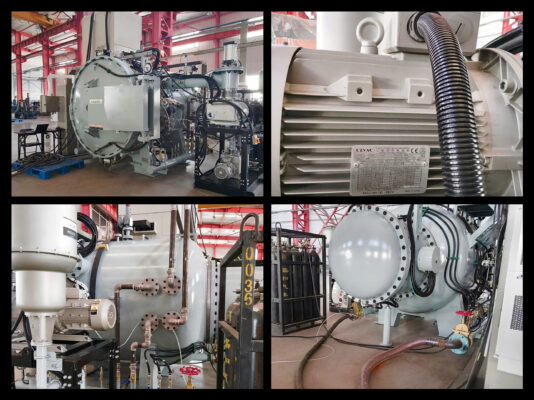
Actual ULVAC Vacuum Heat Treatment Furnace System
Contact ULVAC Vietnam today for expert consultation on the most suitable vacuum furnace solution for your manufacturing needs.