As manufacturers continue to accelerate digital transformation and move toward Smart Factory environments, leak testing is no longer expected to provide only high accuracy. It must also deliver fast cycle times, complete data traceability, and seamless integration with automated production lines.
As a result, today’s Auto Leak Test Machine is no longer a standalone inspection device. Instead, it has become an integral part of modern manufacturing automation systems. By integrating with industrial robots, PLCs, HMIs, vision systems, barcode scanners, and MES/SCADA platforms, manufacturers can improve productivity, minimize human error, and optimize production processes.
In this article, we will explore how Auto Leak Test Machines are integrated with Robots and PLCs to create a fully automated leak testing system.
What Is an Auto Leak Test Machine?
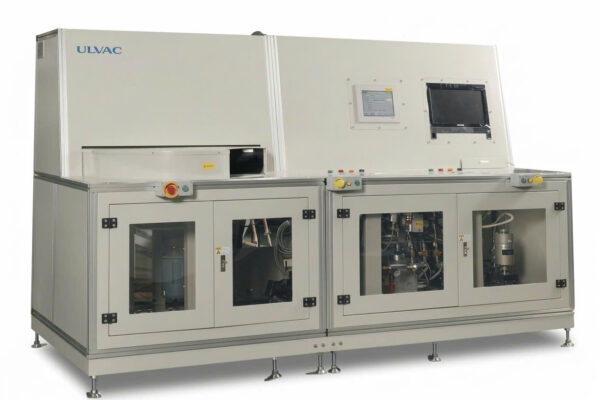
An Auto Leak Test Machine is an automated system designed to verify the airtightness of products using various leak testing methods, including:
- Helium Leak Test
- Pressure Decay Test
- Vacuum Decay Test
- Air Leak Test
The system can automatically perform the following operations:
- Receive the product
- Position and clamp the product
- Generate vacuum
- Perform leak testing
- Judge Pass (OK) or Fail (NG)
- Sort inspected products
- Send inspection data to the manufacturing management system
The entire process is controlled by a PLC, allowing continuous 24/7 operation with minimal operator intervention.
The Role of PLC in an Auto Leak Test Machine
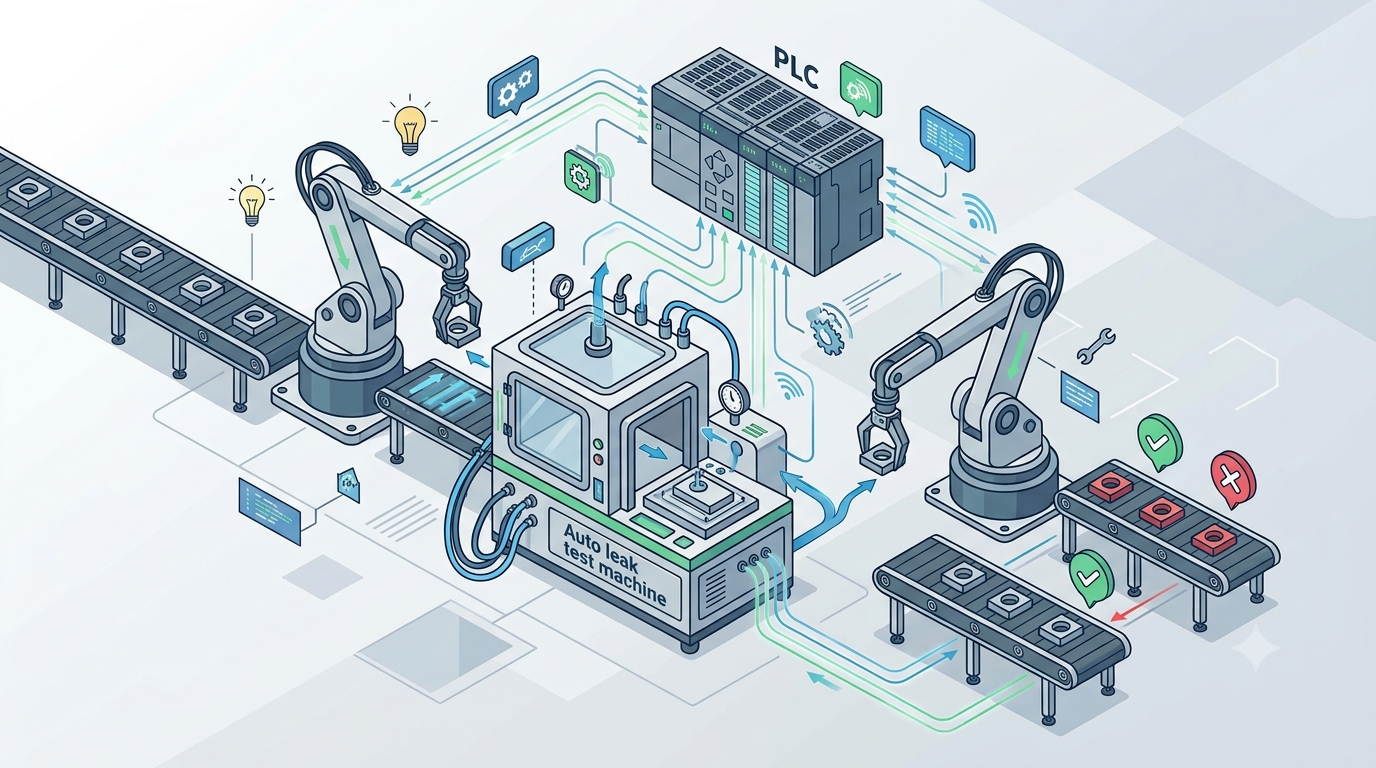
The Programmable Logic Controller (PLC) serves as the central controller of the entire leak testing system.
Its primary responsibilities include:
- Controlling the inspection sequence
- Operating vacuum valves
- Controlling vacuum pumps
- Operating pneumatic cylinders
- Communicating with industrial robots
- Collecting sensor signals
- Interfacing with the Helium Leak Detector
- Controlling the HMI (Human-Machine Interface)
- Transmitting production data to MES or SCADA systems
A single PLC can manage hundreds of digital and analog I/O signals simultaneously.
How Does the PLC Control the Leak Testing Process?
A typical automated leak test cycle consists of the following steps:
Step 1. Robot Loads the Product into the Fixture
The robot picks up the product from the conveyor or feeder and places it precisely into the fixture.
The PLC confirms:
- Product Loaded
- Fixture Closed
Step 2. Close the Test Chamber
The PLC controls:
- Pneumatic cylinders
- Servo actuators
- Vacuum chamber door
It then verifies:
- Chamber Closed
Step 3. Create Vacuum
The PLC activates:
- Vacuum Pump
- Vacuum Valves
At the same time, it continuously monitors:
- Vacuum Sensor
- Pressure Sensor
Once the target vacuum level is reached, the inspection proceeds automatically.
Step 4. Helium Charging
The PLC controls:
- Helium Valve
- Mass Flow Controller (MFC)
Helium is introduced into the product according to the preset pressure and filling time.
Step 5. Leak Testing
The PLC sends a Start Test command to the Helium Leak Detector.
The detector returns:
- Leak Rate
- Pass
- Fail
The PLC processes and stores all inspection results.
Step 6. Robot Unloads the Product
If the result is:
OK
↓
The robot transfers the product to the OK tray.
If the result is:
NG
↓
The robot automatically places the product into the NG tray.
The entire process is completed automatically without operator intervention.
The Role of Robots in an Auto Leak Test Machine
Industrial robots eliminate repetitive manual handling and significantly improve production efficiency.
1. Loading
The robot can pick products from:
- Conveyor
- AGV
- Tray
- Magazine
2. Precision Positioning
The robot accurately places each product into the fixture.
Typical positioning accuracy:
±0.02 mm
This high precision is critical because even a slight misalignment may affect leak test accuracy.
3. Sorting
After inspection, the robot automatically classifies products into:
- OK
- NG
- Rework
4. Palletizing
The robot can also perform:
- Tray loading
- Palletizing
- Automatic transfer to the next production process
How Do Robots and PLCs Communicate?
Industrial communication is typically established using:
- Ethernet/IP
- PROFINET
- EtherCAT
- Modbus TCP
- CC-Link IE
For example:
The robot sends status signals such as:
- Ready
- Busy
- Error
- Complete
The PLC sends commands including:
- Start
- Stop
- Reset
- Product Type
- Recipe Number
This real-time communication ensures stable, synchronized operation across the production line.
Equipment That Can Be Integrated with an Auto Leak Test Machine
In addition to Robots and PLCs, the system can also integrate with:
| Equipment | Function |
|---|---|
| Vision Camera | Visual inspection and product positioning |
| Barcode Scanner | Product identification and traceability |
| QR Code Reader | Automatic product recognition |
| RFID | Contactless product identification |
| MES | Manufacturing execution and production management |
| SCADA | Real-time system monitoring |
| ERP | Enterprise resource planning integration |
| AGV | Automated material transportation |
| Conveyor | Product loading and unloading |
| Label Printer | Printing inspection result labels |
Benefits of Integrating Robots and PLCs
1. Higher Productivity
Automation significantly reduces inspection cycle time, making high-volume production more efficient.
2. Reduced Human Error
Robots perform repetitive tasks with consistent precision, minimizing operator-related errors.
3. Complete Data Traceability
Each inspected product can store:
- Serial Number
- Leak Rate
- Inspection Time
- Operator Information
- Product Model
- Recipe
This is especially important for industries requiring strict traceability, such as automotive, EV batteries, and electronics.
4. Easy Scalability
As production demand increases, additional robots or inspection stations can be added without redesigning the entire system.
5. Smart Factory Integration
The leak testing system can connect with:
- MES
- SCADA
- ERP
- Cloud Platforms
- Real-Time Dashboards
This enables manufacturers to monitor production status, analyze performance, and make data-driven decisions.
Typical Applications
Auto Leak Test Machines integrated with Robots and PLCs are widely used in:
- Automotive Components
- HVAC Systems
- Heat Exchangers
- Cooling Modules
- EV Batteries
- Electric Motors (E-Motors)
- Industrial Valves
- Pressure Vessels
- Medical Devices
- Semiconductor Components
- Data Center Cooling Equipment
Future Development Trends
As Smart Factories continue to evolve, Auto Leak Test Machines are becoming increasingly intelligent through technologies such as:
- AI-based leak trend analysis and early fault detection
- IIoT connectivity for remote monitoring
- Automatic Recipe Management for multiple product types
- Predictive Maintenance based on operational data
- Digital Twin integration for production simulation and optimization
These innovations not only improve inspection quality but also reduce operating costs and increase long-term manufacturing efficiency.
Conclusion
Integrating Robots and PLCs into an Auto Leak Test Machine goes far beyond simple automation. It creates a highly intelligent inspection system capable of stable operation, complete data traceability, high accuracy, and excellent scalability.
For manufacturers in the automotive, HVAC, EV battery, semiconductor, and electronics industries, this solution improves product quality, reduces defect rates, and helps meet increasingly demanding production standards.
Customized Auto Leak Test Solutions for Your Production Line
ULVAC Vietnam provides customized Auto Leak Test Machine solutions tailored to each customer’s production requirements, with seamless integration of:
- Helium Leak Detector
- ULVAC Vacuum Pumps
- Vacuum Chambers
- Industrial Robots
- PLC / HMI
- Vision Systems
- Barcode & RFID Systems
- MES / SCADA
- Helium Recovery Systems
ULVAC Vietnam’s experienced engineering team supports customers throughout every stage—from site surveys and system design to installation, commissioning, maintenance, and technical support—helping manufacturers build highly accurate, cost-effective, and Smart Factory-ready leak testing systems.
Contact ULVAC Vietnam today to discuss the ideal Auto Leak Test solution for your production line.