In the vacuum engineering industry, one critical mistake still happens every day in many factories: using standard pneumatic valves in vacuum systems, or selecting the wrong valve category (low, medium, or high vacuum) for the production process.
Many people assume:
“A valve is just a valve — as long as it can open and close the pipeline, it should work.”
However, this mindset is extremely dangerous. The physical behavior of positive pressure (compressed air) and negative pressure (vacuum) is fundamentally different.
As a result, choosing the wrong valve for a vacuum system can lead to serious technical failures.
1. The System Cannot Reach the Required Vacuum Pressure
Standard pneumatic valves are designed to prevent internal pressure from leaking outward.
In contrast, within a vacuum environment, atmospheric pressure outside the system constantly tries to penetrate through even the smallest gaps. 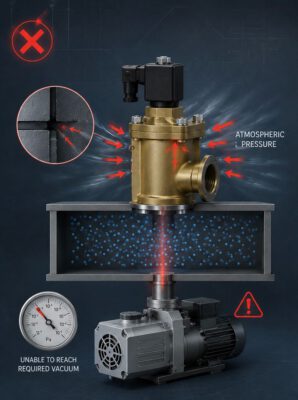
As a result, gas leakage occurs.
Even if the vacuum pump has high capacity, it must operate continuously while the chamber pressure still cannot reach the required level.
For example, the system may need to achieve:
10⁻³ Pa → 10⁻⁵ Pa
However, due to leakage from an unsuitable valve, pressure fluctuations occur continuously and the vacuum level becomes unstable.
This leads to:
- Increased power consumption
- Reduced operating efficiency
- Higher load on the vacuum pump
- Longer production cycles
2. Internal Valve Damage Caused by “Reverse Deformation”
Sealing components such as gaskets, diaphragms, and pistons in standard pneumatic valves are designed to withstand pressure pushing outward from inside the valve.
However, under deep vacuum conditions, the large pressure differential creates a reverse suction force opposite to the original design direction.
Consequently, internal valve components can quickly suffer from:
- Deformation
- Torn seals
- Cracked diaphragms
- Loss of sealing performance

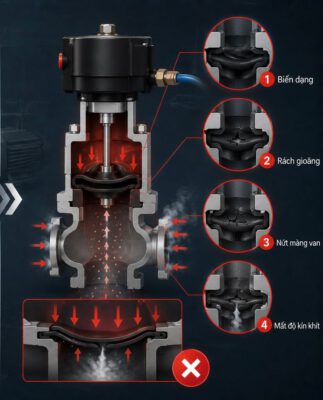
After a short operating period, the valve may no longer function properly.
In addition, frequent replacement significantly increases maintenance costs for the factory.
3. Vacuum Contamination – The “Enemy” of Semiconductor and Thin-Film Industries
This is an extremely serious risk that is often overlooked.
Conventional pneumatic valves typically use standard lubricating oil to ensure smooth piston movement. However, in high-vacuum environments, low pressure reduces the boiling point of liquids.
As a result, lubricants and contaminants inside the valve begin to outgas.
These vaporized oil molecules diffuse backward into the vacuum chamber and deposit onto product surfaces.
The consequence can be catastrophic: an entire production batch worth hundreds of thousands — or even millions — of dollars may become defective.
This is especially critical in industries such as:
- Semiconductor manufacturing
- OLED production
- EV battery coating
In these applications, even microscopic contamination can destroy the entire process. 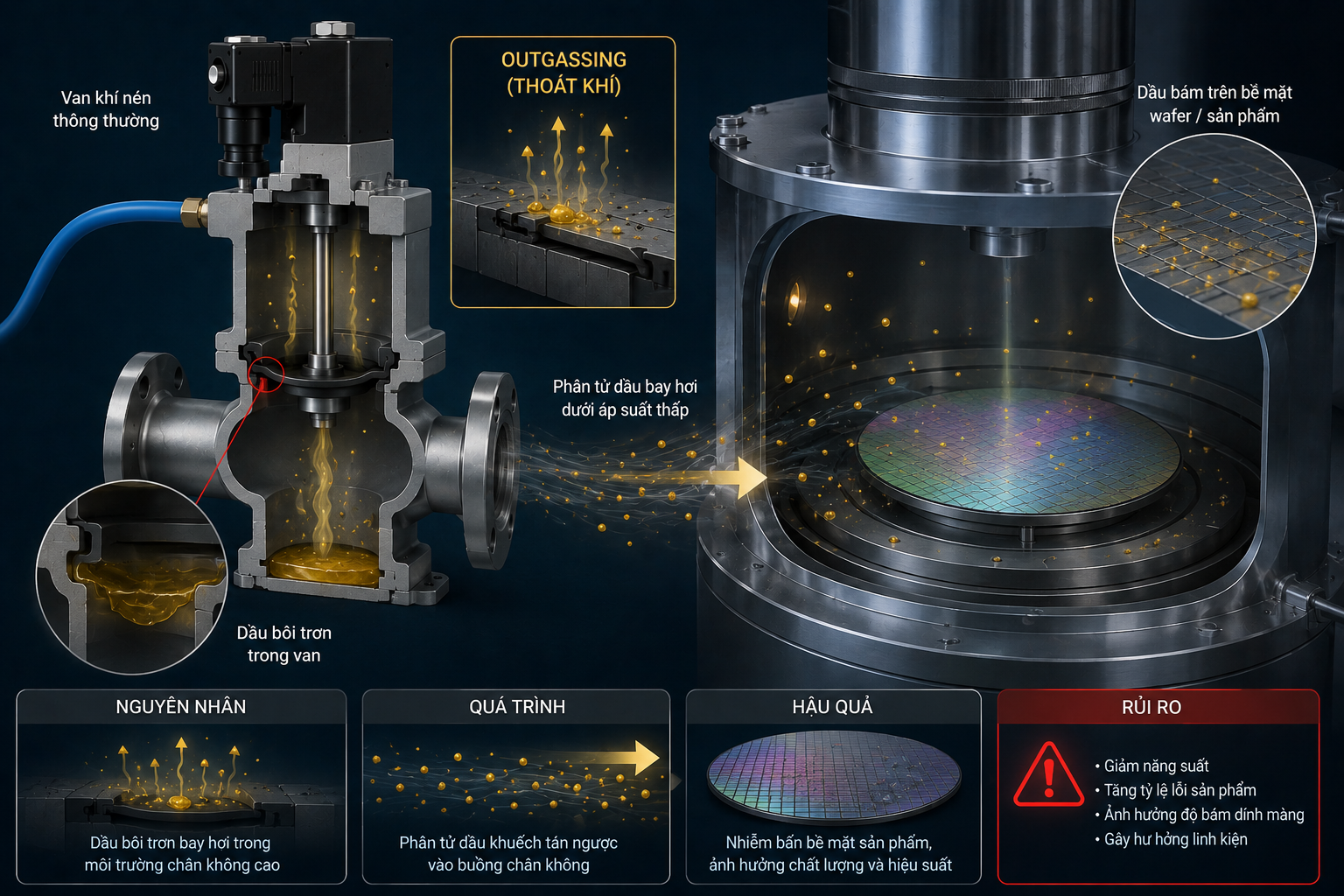
4. The Silent Killer That Shortens Vacuum Pump Lifetime
When a valve leaks or cannot fully seal, the vacuum pump must continuously compensate for pressure loss.
This is particularly dangerous for:
- Diffusion pumps
- Turbo molecular pumps
- High-vacuum systems
Over time, the pump may experience:
- Overheating
- Accelerated wear
- Vacuum oil oxidation
- Reduced bearing lifespan
Eventually, repair costs become far higher than the cost of selecting the correct valve from the beginning.
5. How to Choose the Right Vacuum Valve
To avoid these problems, vacuum systems must use valves specifically designed for vacuum applications.
A proper vacuum valve should meet the following requirements:
Specialized Materials to Prevent Outgassing
Valve bodies are typically manufactured from Q235 steel or specially treated stainless steel to minimize outgassing in vacuum environments.
As a result, the system can maintain stable clean vacuum conditions over long operating periods.
Ultra-High Leak Tightness
Vacuum valves must achieve extremely low leak rates.
For example, ULVAC’s VLPCD Series achieves:
< 1.5 × 10⁻⁷ Pa·m³/s 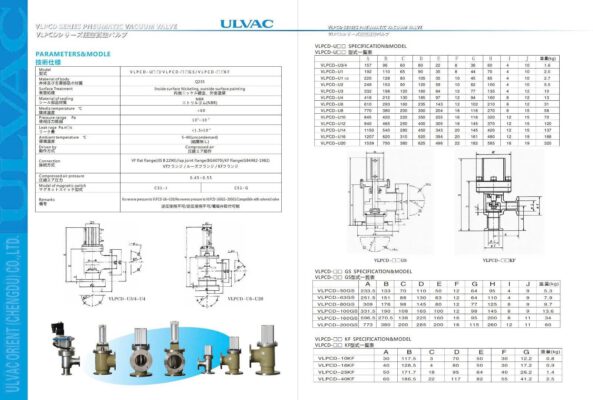
This ultra-low leak rate allows stable operation even in high-vacuum applications.
Seals Designed for Negative Pressure
Vacuum valves also require specialized Viton or NBR seals.
These materials offer:
- Resistance to large pressure differentials
- No deformation under vacuum conditions
- Excellent chemical resistance
- Long-term sealing stability
FAQ – Frequently Asked Questions
Q1: Why can’t pneumatic valves and vacuum valves be used interchangeably if they share the same pipe size?
Answer:
Pneumatic valves are designed to withstand outward pressure, while vacuum valves are designed to resist inward suction force.
Therefore, using a pneumatic valve in a vacuum system will quickly deform the gasket and cause immediate leakage.
Q2: How does outgassing damage components?
Answer:
Under high vacuum conditions, lubricants and contaminants inside standard valves evaporate.
These particles then adhere to semiconductor wafers or coating surfaces, causing contamination and product failure.
Q3: ULVAC VLPCD valves use compressed air. Can compressed air leak into the vacuum chamber?
Answer:
No.
Compressed air only actuates the piston mechanism inside an isolated upper chamber. This section is completely separated from the vacuum flow path below. 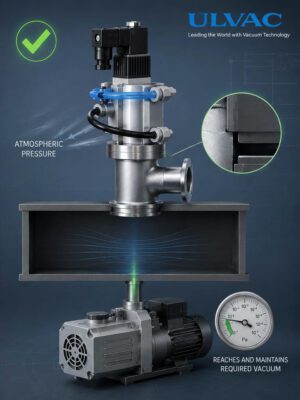
Q4: When should KF flanges be used, and when should VF/GS flanges be selected?
Answer:
- KF flanges: Suitable for small pipes requiring quick manual assembly, commonly used in laboratories and semiconductor applications.
- VF/GS flanges: Suitable for larger pipelines requiring bolted connections and higher mechanical strength in industrial vacuum systems.
Q5: What does “No Reverse Pressure” mean?
Answer:
The valve is designed to withstand pressure in only one specific direction.
Therefore, the valve must be installed according to the flow direction arrow. Incorrect installation may tear the gasket or damage the valve disc.
Advice from ULVAC Vietnam Experts
Do not let a small mistake in valve selection affect your entire multi-million-dollar production line.
In reality, compressed air systems and vacuum systems operate under completely different physical principles. Therefore, using a dedicated vacuum valve is not optional — it is essential.
If your system is experiencing:
- Unstable vacuum pressure
- Slow pump-down time
- Vacuum instability
- Difficult-to-detect leakage
then the valve may be the weak point of the entire system.
If you need support selecting KF, VF, or GS flange valves for your application, contact the engineering team at ULVAC Vietnam for professional consultation and the most suitable vacuum solution.