In vacuum heat treatment technology, achieving low pressure is only the beginning. For products to achieve uniform mechanical properties and high precision, Temperature Uniformity within the vacuum furnace is the deciding factor. At ULVAC, this is considered a vital standard for evaluating system performance.
1. What is Vacuum Furnace Temperature Uniformity?
Temperature Uniformity is the maximum allowable temperature difference between the hottest and coldest points within the Work Zone once the vacuum furnace has reached a steady state.
In a vacuum environment, there is no air to facilitate convective heat transfer; therefore, heat is transferred solely via radiation. This makes maintaining thermal equilibrium at every position significantly more challenging than in conventional furnaces.
According to AMS2750 Class 2 standards, temperature uniformity must be maintained within ±6°C.
2. Serious Consequences of Poor Temperature Uniformity
If a furnace fails to meet uniformity standards, businesses face several risks:
-
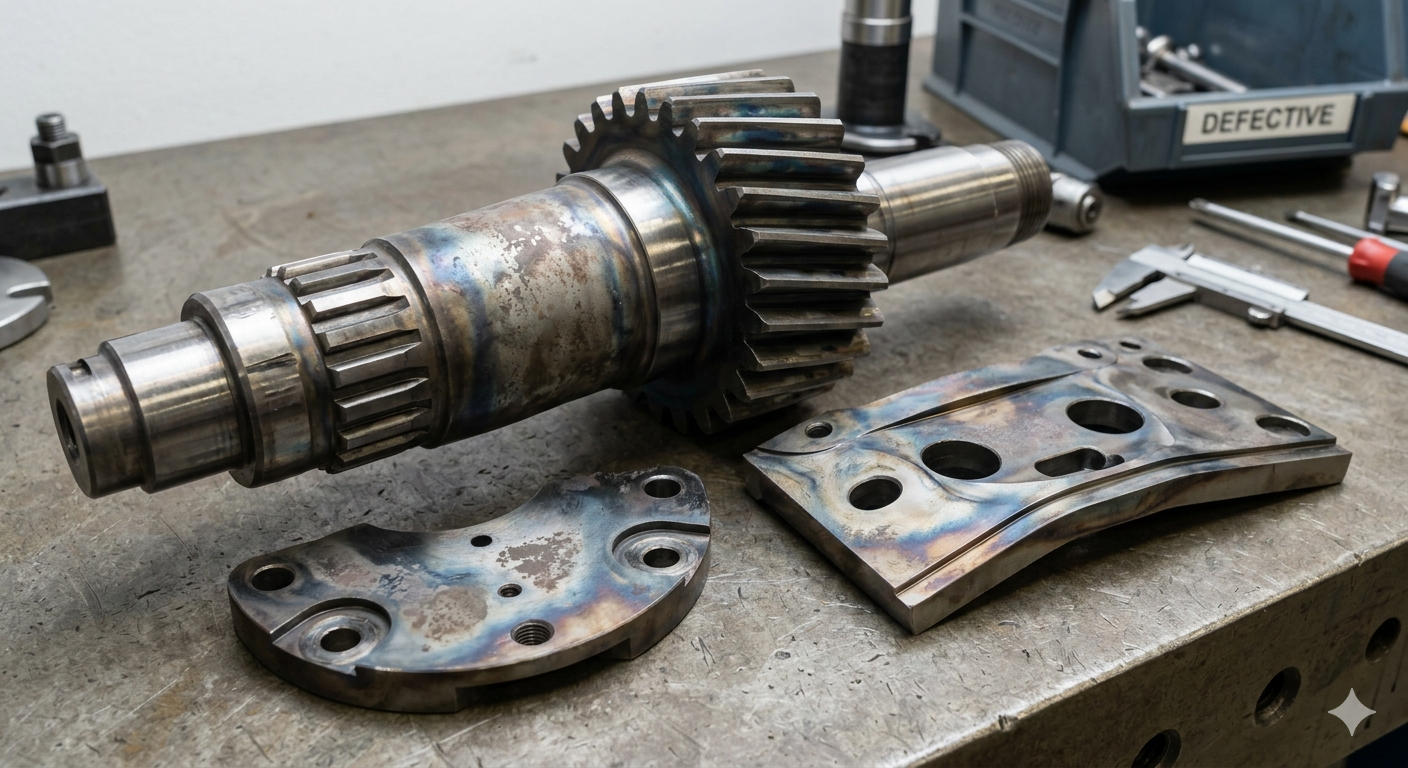
Distortion and Deformation: Uneven thermal expansion generates internal stresses, leading to warped or deformed components.
-
Inconsistent Hardness: Overheated zones cause grain coarsening, making the material brittle. Conversely, underheated zones fail to reach the required hardness.
-
Brazing Failures: In brazing processes, non-uniform temperatures cause irregular filler metal flow, resulting in gaps or burnt joints.
-
Increased Production Costs: Higher Non-Conformance (NG) rates and wasted energy due to unnecessarily prolonged soaking times.
 Images of products with distortion, inconsistent hardness, and substandard surface color.
3. ULVAC’s 9-Point Calibration Process for Vacuum Furnaces
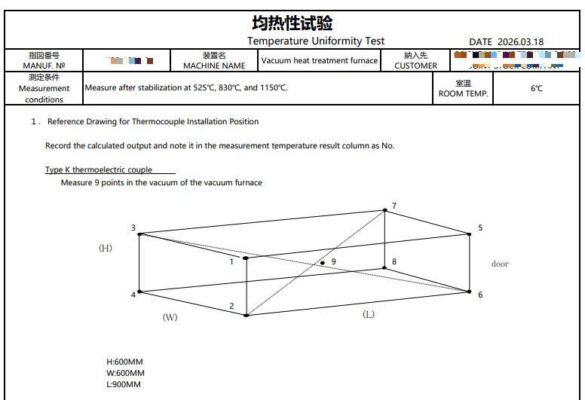
To ensure the stability of the work zone, ULVAC implements a rigorous 9-point Temperature Uniformity Survey (TUS).
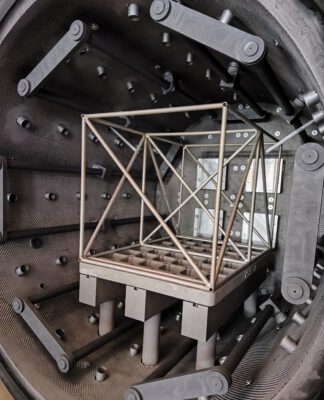
Specifically, 8 sensors are placed at the 8 corners of the work zone, while 1 sensor is positioned at the geometric center. This layout eliminates thermal “blind spots” and ensures no cold zones remain within the chamber.
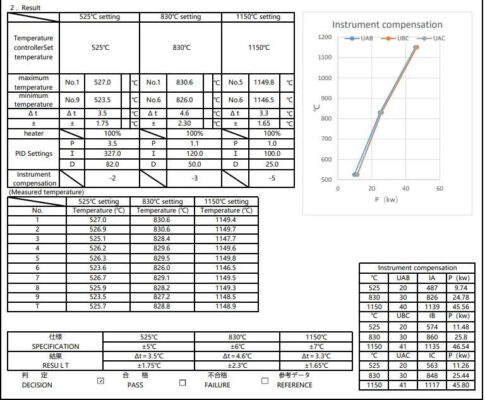
Actual Result: TUS tests at ULVAC facilities have achieved ±2.3°C, significantly exceeding customer requirements. This allows clients to comply with international standards such as AMS2750 (Aerospace) or CQI-9 (Automotive).
4. Factors Affecting Temperature Uniformity
Several key factors directly impact thermal balance:
-
Heating System: ULVAC furnaces utilize a 360° heating element arrangement, ensuring radiant heat covers the entire space evenly.
-
Insulation Materials: Contaminated or damaged graphite felt or metal shields cause localized heat loss.
-
Load Configuration: Overpacking parts can create a “shadow effect,” obstructing radiant heat paths.
5. FAQ – Quick Answers
-
Q: Why does the control panel show the correct temperature, yet the products are defective?
-
A: The control thermocouple only measures at a single point, usually near the heating elements. Only a 9-point TUS reflects the actual temperature at the product’s location.
-
-
Q: How often should Temperature Uniformity be checked?
-
A: Periodically every 3–6 months, or immediately following any repairs to the heating or insulation systems.
-
-
Q: How can uniformity be improved when the furnace is fully loaded?
-
A: Use high-porosity fixtures, extend the soaking time, or utilize inert gas convection heating if the furnace supports it.
-
6. Expert Advice from ULVAC
Do not operate your furnace passively; aim to “understand” its thermal behavior. Performing periodic Clean-up runs combined with regular TUS inspections will protect high-value batches and significantly extend the lifespan of your equipment.