Vacuum Evaporation is a Physical Vapor Deposition (PVD) method used to create thin films on wafers and other substrates. The process uses a vacuum environment to evaporate a source material, after which the resulting atoms or molecules travel through the vacuum and condense onto the substrate surface.
With precise control over film thickness and thin-film properties, Vacuum Evaporation is widely used in semiconductor manufacturing, electronics, display manufacturing, and optical coating.
1. How Does Vacuum Evaporation Work?
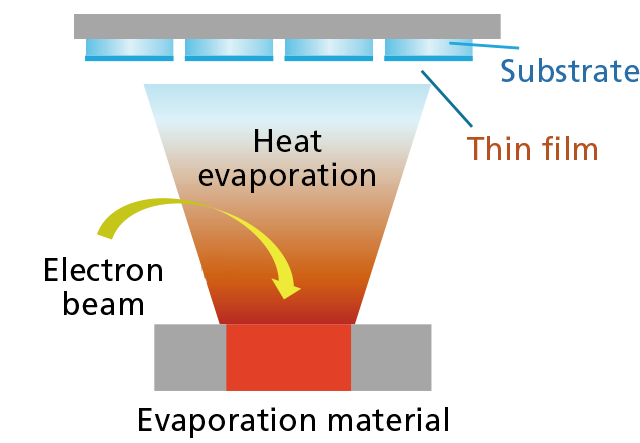
The basic Vacuum Evaporation process consists of the following steps:
Vacuum Pumping → Heating → Evaporation → Vapor Transport → Film Deposition
- Vacuum Pumping: A vacuum pump reduces the pressure inside the chamber to the required level.
- Heating: The source material is heated using resistance heating, electron beam heating, or another suitable method.
- Evaporation: The material evaporates or sublimates into atoms or molecules.
- Deposition: The vaporized material travels through the vacuum and condenses on the substrate to form a thin film.
A controlled vacuum environment reduces collisions between the evaporated material and residual gas molecules, helping maintain film thickness, purity, and deposition stability.
2. Why Is Vacuum Important in Evaporation?
The quality and stability of the deposition process depend significantly on the vacuum conditions inside the chamber.
If the required vacuum level is not achieved or the pressure is unstable, the process may be affected by:
- Non-uniform film thickness
- Unstable deposition rate
- Contamination
- Longer pump-down time
- Reduced process repeatability
Therefore, vacuum pumps, vacuum gauges, vacuum valves, and chamber leak-tightness are all important components of a reliable Vacuum Evaporation system.
3. Vacuum Evaporation vs. Sputtering
Both Vacuum Evaporation and Sputtering are PVD methods, but they use different mechanisms to deposit thin films. 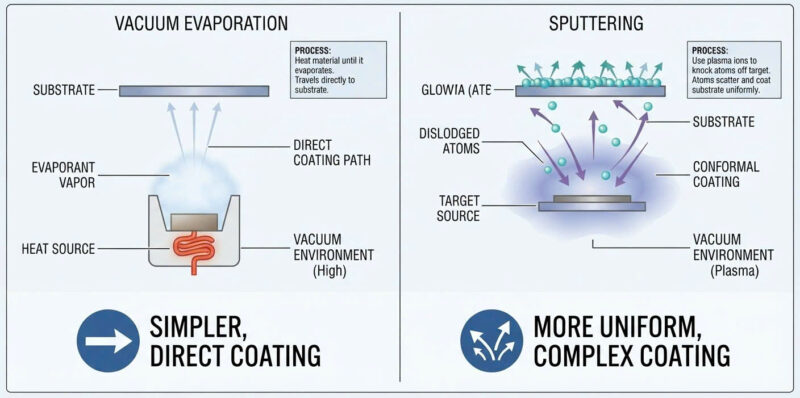
| Vacuum Evaporation | Sputtering |
|---|---|
| Evaporates the source material using heat | Uses plasma ions to bombard a target |
| Vaporized material → substrate | Sputtered material from target → substrate |
| Suitable for various thin-film applications | Widely used in semiconductor and electronics manufacturing |
The appropriate deposition method depends on the material, film thickness, uniformity, deposition rate, and specific process requirements.
4. Applications of Vacuum Evaporation
Vacuum Evaporation can be used in a wide range of applications, including:
- Semiconductor manufacturing
- Thin-film deposition
- Display manufacturing
- Electronics
- Optical coating
- Metal coating
In semiconductor manufacturing, Vacuum Evaporation can be used to deposit thin material layers such as metal layers and electrodes in selected device fabrication processes.
5. ULVAC Vietnam – Vacuum Solutions for Semiconductor Manufacturing
ULVAC Vietnam provides vacuum equipment and services for semiconductor manufacturing and thin-film processes, including:
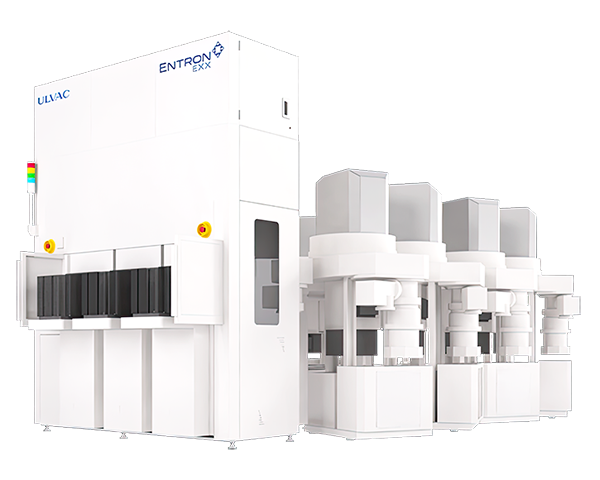
Vacuum Equipment
- PVD / Sputtering
- Vacuum Evaporation
- CVD / PE-CVD
- Dry Etching
- Plasma Ashing
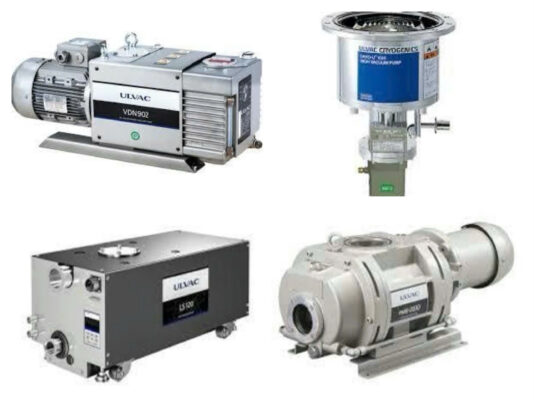
Vacuum Pumps & Components
- Rotary Vane Pumps, Roots / Booster Pumps, Diffusion Pumps, Turbo Molecular Pumps, and Cryogenic Pumps
- Vacuum Gauges & Valves

Leak Detection
ULVAC Vietnam provides Helium Leak Detection and Automatic Leak Test solutions that can be integrated with PLC, HMI, Robot, Vision, Barcode, MES, and SCADA systems according to specific production line requirements. 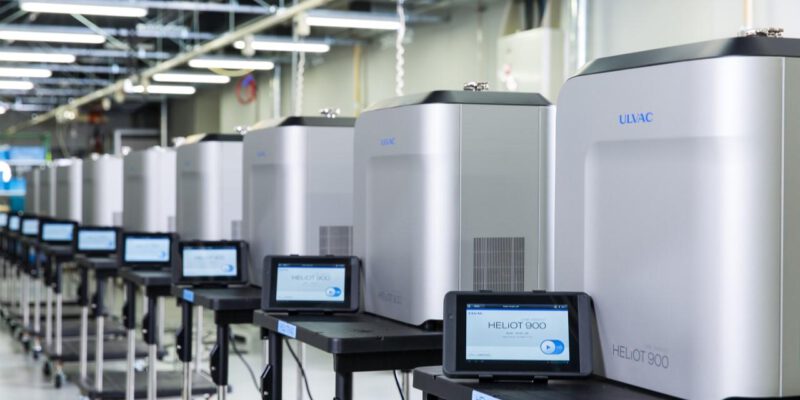
Installation & Maintenance
ULVAC Vietnam provides:
- Vacuum equipment installation
- Preventive maintenance
- Vacuum pump maintenance and overhaul
- Troubleshooting
- Leak detection
- Technical support and solution consulting
Proper control of vacuum performance, leakage, and pump condition helps manufacturers maintain process stability and reduce unexpected downtime.
Conclusion
Vacuum Evaporation is an important technology for thin-film deposition, where a stable vacuum environment plays a critical role in maintaining consistent process conditions.
From vacuum equipment, vacuum pumps, and components to leak detection, installation, and maintenance, ULVAC Vietnam provides comprehensive vacuum solutions for semiconductor manufacturing and advanced manufacturing applications.
Contact ULVAC Vietnam to discuss a Vacuum Evaporation or vacuum system solution tailored to your specific production requirements.