In an industrial vacuum system, a PLC typically handles familiar control functions such as starting and stopping a vacuum pump, controlling valves, and receiving signals from sensors.
But if a PLC is used only to “turn the pump on and off,” is the system really protected against abnormal conditions?
With a properly designed PLC program, the system can do much more than basic ON/OFF control. A PLC can monitor the vacuum generation process, track pressure over time, and detect abnormal operating conditions.
One particularly useful function is detecting a potential vacuum pump jam based on whether the pressure reaches a preset value within a specified period of time.
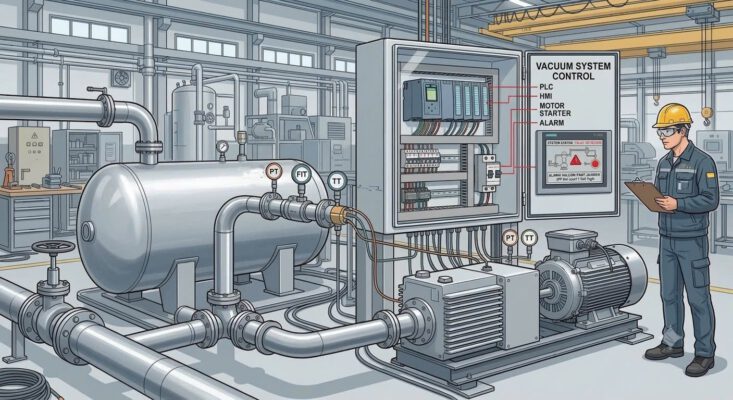
When an abnormal condition is detected, the system can display an alarm on the HMI and stop the pump, helping prevent the vacuum pump from continuing to operate under abnormal conditions.
1. A PLC in a Vacuum System Does More Than Turn the Pump On and Off
In a basic control system, a PLC may simply execute:
Pump Start → Vacuum Pump ON
and:
Pump Stop → Vacuum Pump OFF
However, a more advanced automated vacuum system may require the PLC to monitor the actual system condition after the vacuum pump starts.
For example, after the vacuum pump is turned on, the system is expected to reduce the pressure to a preset value within a specified period of time.
If the required pressure is not reached, this may indicate that the system is experiencing an abnormal condition.
Possible causes may include:
- The vacuum pump is jammed or operating abnormally
- A major leak is present in the vacuum system
- A vacuum valve is not operating correctly
- Problems with vacuum piping or connections
- Improper operating conditions
- Other factors preventing the system from reaching the required vacuum level
This is where PLC control logic becomes important.
2. What Problems Can a Jammed Vacuum Pump Cause?
A vacuum pump must operate reliably to maintain the required vacuum level throughout the process.
When a pump becomes jammed, its internal moving components may no longer operate normally. Depending on the pump and motor configuration, this condition can lead to increased current, motor overload, or excessive motor temperature.
If the abnormal condition is not detected and addressed promptly, the failure may develop into a chain reaction:
Pump Jam → Motor Overload → Temperature Rise → Risk of Motor Burnout/Damage → Vacuum Pump Shutdown → Production Downtime
The impact is not limited to the pump itself. If vacuum is a critical condition in the production process, a vacuum pump failure can also interrupt the entire production line.
Therefore, detecting abnormal conditions as early as possible is extremely important.
3. An Important Point: Not Every PLC System Has This Function
This is an important detail that is often overlooked.
Having a PLC does not automatically mean that the system has a vacuum pump jam detection function.
A PLC only performs the functions that have been specifically designed and programmed into the control system.
A basic PLC system may only perform:
ON → Pump Running
Meanwhile, a system with dedicated monitoring logic can perform:
Pump ON → Monitor Pressure → Timer → Check Pressure → Alarm → Pump Stop
The difference lies in the PLC program and protection logic integrated into the system.
In other words, the PLC does not simply “tell” the pump to run. It can also be programmed to check whether the system has reached the expected operating condition after the pump starts.
4. How Does a PLC Detect a Potential Pump Jam Using Pressure and a Timer?
One approach is to monitor the vacuum pressure over a predefined period using a timer.
The basic operating principle can be summarized as:
Pump ON → Start Timer → Monitor Pressure → Check Preset Value
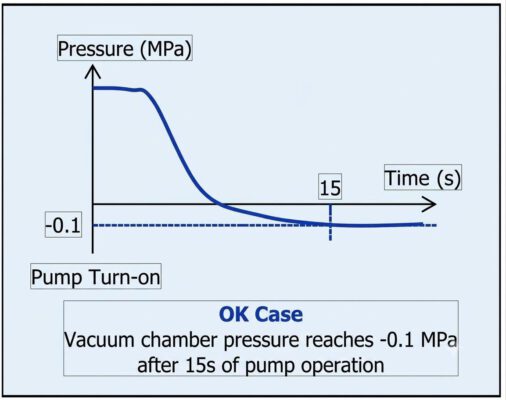
If the pressure reaches the required value within the specified time:
Pressure OK → Pump Continues Normal Operation
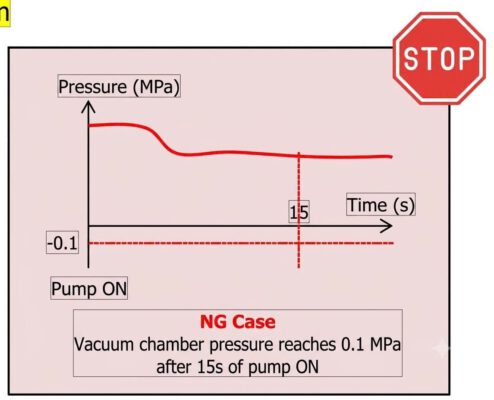
However, if the timer expires and the pressure has still not reached the preset value:
Pressure NG → HMI Alarm → Pump Stop
Step 1: Start the Vacuum Pump
When the system receives a start command, the PLC sends a signal to start the vacuum pump.
Immediately after the pump starts, the PLC activates the Timer programmed into the control system.
For example:
After the vacuum pump starts, a specified period is allowed for the system pressure to reach the required value.
The appropriate timer setting should be determined based on the actual characteristics of the vacuum system, including the vacuum pump type, chamber volume, piping configuration, and process requirements.
Step 2: Monitor the Vacuum Pressure
While the timer is running, the PLC continuously monitors the pressure signal.
The PLC checks:
Has the pressure reached the preset value?
If the pressure reaches the required value before the timer expires, the system determines that the pump-down process is proceeding normally.
Step 3: Pressure Does Not Reach the Preset Value Within the Set Time
If the timer expires while the pressure is still above the required vacuum level, the PLC identifies the condition as an abnormal system condition.
Possible causes include:
- A jammed or abnormal vacuum pump
- A major vacuum leak
- Problems with valves or vacuum piping
- Improper operating conditions
At this point, the system does not simply allow the pump to continue operating without intervention.
Step 4: Display an Alarm on the HMI
The PLC sends a signal to the HMI (Human-Machine Interface) to notify the operator.
For example:
VACUUM PRESSURE NOT REACHED
CHECK PUMP OR SYSTEM LEAK
This allows technicians to quickly recognize that the system has failed to reach the required pressure within the specified time.
Step 5: Stop the Pump for Protection
Once an abnormal condition is detected, the PLC can execute a STOP command for the vacuum pump according to the protection logic designed for the system.
Stopping the pump helps prevent the equipment from continuing to operate under abnormal conditions and can therefore reduce the risk of motor overload and damage.
The complete logic can be illustrated as follows:
Pump ON
↓
Start Timer
↓
Monitor Pressure
↓
Has the pressure reached the preset value?
↓
YES → Pump continues normal operation
NO → HMI Alarm → Pump STOP
↓
Check Pump / Vacuum System / Leak
|
|
|
5. A Small PLC Program Can Make a Big Difference
The important point is that this function does not necessarily require a complicated control system.
A properly designed PLC logic can combine three key parameters:
Pressure + Time + Pump Status
The PLC uses these signals and conditions to make a control decision.
For example:
Pump is ON, but the pressure does not reach the required level within the preset time → System generates an alarm and stops the pump.
The PLC is therefore not simply checking:
“I turned the pump on.”
It is also checking:
“After starting the pump, has the system actually reached the required vacuum condition?”
This represents an important transition from basic equipment control to system monitoring and equipment protection.
6. How HMI Helps Operators Detect Problems Faster
The PLC handles the control logic, while the HMI provides the interface between the control system and the operator.
When the pressure fails to reach the preset value within the specified time, the HMI can display an alarm, allowing technicians to quickly investigate the system.
The alarm information can help operators focus their inspection on areas such as:
- Vacuum pump
- Vacuum chamber
- Vacuum piping
- Valves
- Gaskets / O-rings
- Connections
- Potential leak sources
Instead of waiting until the vacuum pump develops a serious failure, operators can identify abnormal conditions during the pump-down process.
7. Protecting the Vacuum Pump Against Overload and Motor Burnout
This is one of the most important benefits of abnormal-condition detection.
If a vacuum pump becomes jammed but continues operating, the motor may be forced to operate under abnormal conditions, increasing the risk of overload and excessive heat generation.
In severe cases, this can result in motor damage.
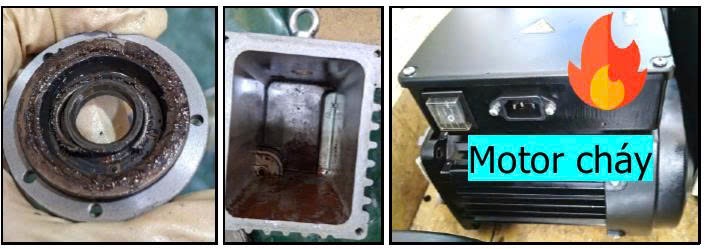
Actual image of a jammed and contaminated vacuum pump with a burned motor.
By using the conditions:
Pump ON + Timer + Pressure Monitoring
the PLC can detect when the system fails to reach the required pressure within the specified time and execute the appropriate protective action according to the system design.
The objective is:
Detect Abnormal Condition → Alarm → Stop Pump → Investigate the Cause
rather than:
Pump Continues Running → Overload → Motor Damage → Production Downtime
Of course, this logic should be considered one layer of system monitoring and protection and should be designed together with the dedicated motor and vacuum pump protection mechanisms appropriate for the application.
8. Not Only Pump Jam Detection – It Can Also Help Identify Major Vacuum Leaks
Another important point is that this logic is not limited to situations where the vacuum pump is jammed.
If the pump is operating normally but the vacuum system has a major leak, the pressure may also fail to reach the preset value within the expected time.
In this case, the PLC can still detect:
Pressure Not Reached → Alarm → Pump Stop
Technicians can then investigate the actual cause of the abnormal condition.
This is why the alarm should not be interpreted as:
“Pressure not reached = the pump is definitely jammed.”
A more accurate interpretation is:
“Pressure not reached within the specified time = the system is experiencing an abnormal condition that requires inspection.”
The actual cause may be related to the vacuum pump, a leak, or another component of the vacuum system.
9. Why Is This Function Worth Considering in a Vacuum System?
In an automated production line, every piece of equipment can affect the overall process.
A vacuum pump is no exception.
A system that only controls the pump through ON/OFF commands provides basic control.
By contrast, a system equipped with:
Pressure Monitoring + Timer + Alarm + Interlock/Stop
can respond more proactively to abnormal operating conditions.
Potential benefits include:
- Early detection of abnormal conditions
- Immediate operator notification
- Reduced pump operating time under abnormal conditions
- Reduced risk of motor overload
- Additional protection for the vacuum pump
- Easier troubleshooting
- Reduced risk of production downtime caused by equipment failure
For production lines that rely heavily on continuous vacuum operation, this type of function is worth considering during the vacuum system control design stage.
10. ULVAC Vietnam – From Vacuum Pumps to Vacuum Control Solutions
An effective vacuum system depends on more than simply selecting the right vacuum pump.
The ability to control, monitor, and protect vacuum equipment is also an important part of reliable operation.
For applications requiring automation, a vacuum system can be designed to integrate:
Vacuum Pump + Pressure Monitoring + PLC + HMI + Alarm + Interlock
Depending on the requirements of each application, the control logic can be designed to monitor the pump-down process and generate an alarm when the system fails to reach the required operating condition.
ULVAC Vietnam provides vacuum-related equipment and solutions and can support customers with vacuum system consultation, integration, and optimization based on their actual production requirements.
Conclusion
A PLC is more than a device for simply turning a vacuum pump ON and OFF.
When properly designed and programmed, a PLC can serve as an important layer of monitoring and protection within a vacuum system.
By combining:
Pump Status → Pressure → Timer → HMI Alarm → Pump Stop
the system can detect when the pressure fails to reach the preset value within the specified time, then generate an alarm and stop the pump according to the programmed protection logic.
This is particularly useful when the abnormal condition may be related to a jammed pump or a major vacuum leak, helping prevent the vacuum pump from continuing to operate under abnormal conditions and reducing the risk of overload-related motor damage.
A PLC program may represent only a small part of an entire control system, but the way that program is designed can make a significant difference.
A PLC does not just tell the pump to run – it can also check whether the vacuum system is operating as expected.
Are You Using a Vacuum Pump in an Automated System?
If your system is experiencing issues such as failure to reach the required vacuum level, slow pump-down, suspected vacuum leaks, or the need for PLC-based alarm and protection functions, ULVAC Vietnam can provide technical consultation based on your actual operating conditions.
Contact ULVAC Vietnam to learn more about vacuum pumps and vacuum system control solutions.